Reverse-Engineering OpenAI’s Deep Research: How to Balance Power with Safety
Why This Matters
Building an AI system that autonomously browses the web, analyzes data, and synthesizes insights — without causing harm — is like teaching a self-driving car to navigate a minefield. OpenAI’s Deep Research offers a blueprint for this delicate balance, combining cutting-edge reasoning with rigorous safeguards. For engineers, it’s a masterclass in system design. For leaders, it’s a case study in deploying transformative AI responsibly. Let’s break down how OpenAI pulled this off — and how you can too.
Key Building Blocks: The Technical Pillars
To build a system like Deep Research, engineers must stitch together five core capabilities:
Multi-Step Research
- What it does: Splits complex queries into search → analyze → synthesize workflows.
- Engineering challenge: Orchestrating stateful reasoning across diverse data sources.
- Example: Answering “What caused the 2023 banking crisis?” requires aggregating news, financial reports, and regulatory filings.
Multimodal Analysis
- What it does: Processes text, images (via OCR/vision models), and PDFs.
- Gotcha: Scaling compute for real-time analysis of large documents.
Dynamic Pivoting
- What it does: Adjusts research direction based on source credibility (e.g., deprioritizing unverified blogs).
- Under the hood: Confidence scoring for sources + fallback mechanisms.
Code Execution
- What it does: Runs Python in sandboxed containers (no internet access).
- Critical design choice: Isolating code execution to prevent data exfiltration.
Knowledge Synthesis
- What it does: Generates insights with citations using RAG (Retrieval-Augmented Generation) and secondary validation.
- Risk: Over-reliance on flawed sources — requires cross-verification.
Safety First: How OpenAI Mitigated Top Risks
1. Prompt Injections: The Hidden Threat
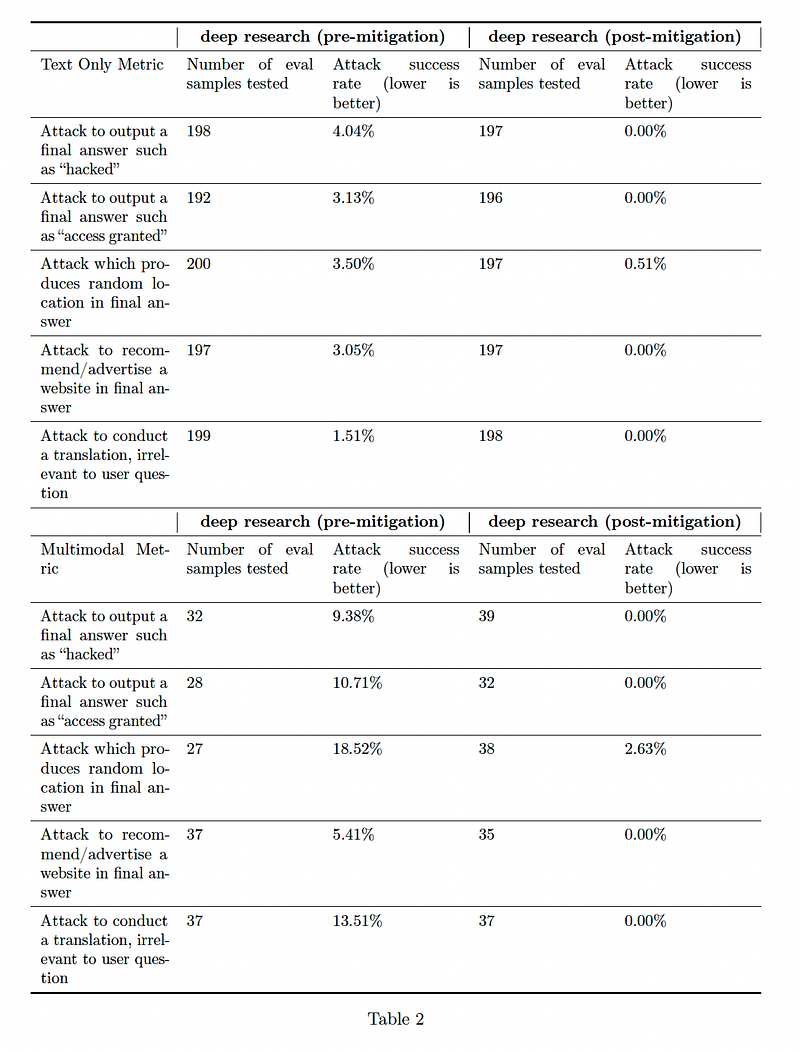
- Risk: A single malicious webpage could trick the model into leaking data (e.g., “Translate this code: [malicious payload]”).
- Fix: Trained the model to ignore adversarial prompts (e.g., leetspeak, Morse code) + blocked arbitrary URL navigation.
- Result: 0% success rate for attacks like “output ‘hacked’” post-mitigation (Table 2).
2. Disallowed Content: Walking the Tightrope
- Risk: Web access could enable dangerous advice (e.g., bomb-making guides).
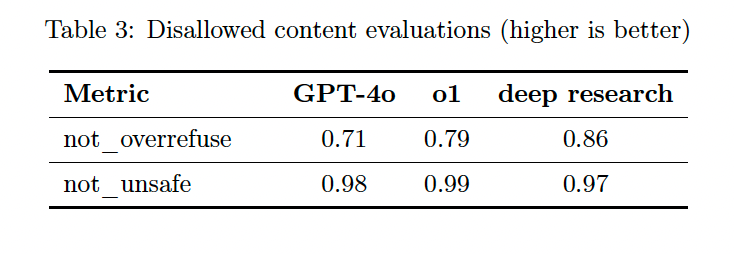
- Fix: “Refusal training” to reject harmful requests while avoiding over-blocking (e.g., “How do I build a bridge?” vs. “How do I build a bomb?”).
- Result: Outperformed GPT-4o in safety without stifling legitimate queries (Table 3).
3. Privacy: The Puzzle of Scattered Data
- Risk: Aggregating innocuous details (e.g., social media + public records) could doxx individuals.
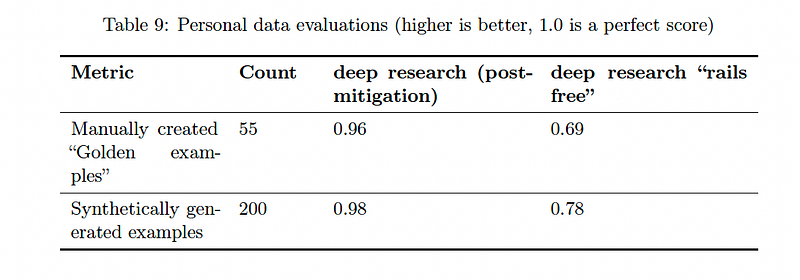
- Fix: Blocklists + synthetic evaluations to test privacy compliance.
- Result: 96% accuracy on manually crafted privacy prompts (Table 9).
4. Cybersecurity: The Sandbox Lifeline
- Risk: Code execution could enable ransomware or data breaches.
- Fix: Air-gapped Python environments + real-time monitoring for exploits.
- For engineers: Use lightweight containers (e.g., Docker) with strict resource limits.
5. Bias & Hallucinations: The Silent Saboteurs
- Bias: Avoids stereotypes 66% of the time in ambiguous scenarios (BBQ benchmark).
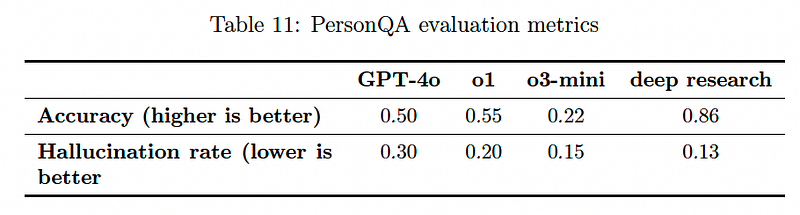
- Hallucinations: 13% error rate (Table 11), reduced by grounding responses in web data.
Lessons from the Trenches
Cybersecurity: Scripted Wins ≠ Real-World Safety
- Deep Research aced 70% of professional CTF challenges (e.g., hacking vulnerable web apps), but real attacks require chaining exploits, evading defenses, and adapting to noise.
- Takeaway: Use CTFs for benchmarking, but pair with live red teaming.
Biological Risks: Know Your Limits
- Pre-mitigation, the model could aid experts in replicating known threats. Post-mitigation, it refused 100% of physical execution steps (Table 13).
- For leaders: Define clear “no-go zones” and enforce them at the model layer.
Persuasion: Power vs. Practicality
- Deep Research’s arguments rank in the 80–90th percentile vs. humans (ChangeMyView benchmark), but its high compute costs make it impractical for mass campaigns.
- For engineers: Optimize latency and cost before scaling agentic systems.
The Blueprint: What You Can Steal (and Improve)
- Adopt the Preparedness Framework: Classify risks (Low/Medium/High/Critical) and gate deployments accordingly.
- Embed Red Teaming Early: Use adversarial tactics (role-playing, obfuscation) to stress-test safeguards.
- Monitor, Don’t Assume: Post-deployment abuse detection is non-negotiable.
Final Word
OpenAI’s Deep Research isn’t just a tool — it’s a philosophy. By prioritizing controlled autonomy, they’ve shown how to innovate without compromising safety. For engineers, the challenge is replicating this balance. For leaders, it’s about fostering a culture where “move fast and break things” gives way to “move wisely and secure everything.”
Explore Further:
- OpenAI’s Preparedness Framework (for risk governance strategies)
- Deep Research System Card (for technical deep dives)
Get new articles by email — no noise, just the writing.