Context Engineering: The Real Secret to Magical AI Agents
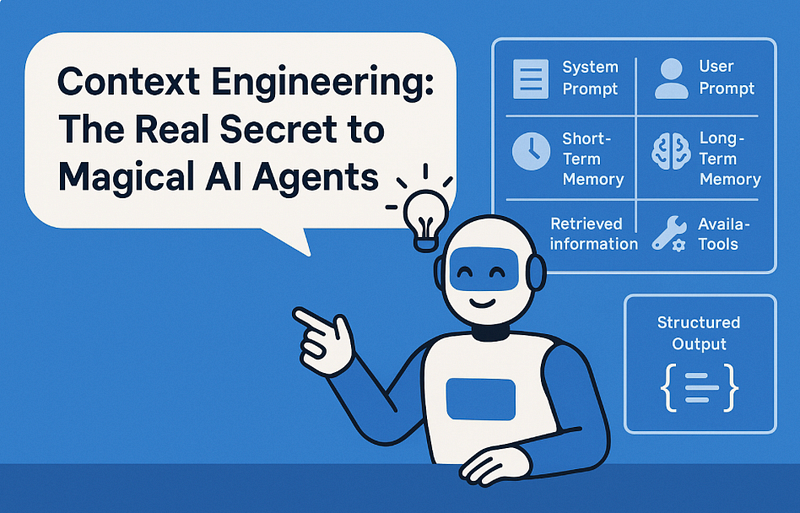
AI is evolving rapidly. The conversation is shifting from “prompt engineering” to something broader: Context Engineering. As Tobi Lutke puts it (source: https://x.com/tobi/status/1935533422589399127), it’s “the art of providing all the context for the task to be plausibly solvable by the LLM.” In other words: the difference between a basic demo and a magical product isn’t the model — it’s the context.
What Is Context?
Context is more than just the prompt. It’s everything the model sees before it responds:
- System Prompt: Sets rules, tone, and examples.
- User Prompt: The immediate question or task.
- Short-Term Memory: The ongoing conversation.
- Long-Term Memory: Persistent knowledge — user preferences, past projects, facts.
- Retrieved Information (RAG): Up-to-date data from documents, APIs, or databases.
- Available Tools: Functions the model can call (e.g., send_email).
- Structured Output: Clear response formats (like JSON).
Why Context Engineering Matters
Most agent failures today aren’t due to the model — they’re due to missing or poor context. Imagine an AI assistant analyzing a stock:
Basic Demo: Only sees the user’s question. Replies with a generic answer or outdated info.
Magical Agent: Sees real-time stock prices, recent news, your portfolio, and relevant financial indicators. It can reason about trends, risks, and tailor advice to your goals. The response is insightful, timely, and actionable.
The magic isn’t in the code. It’s in the context.
From Prompt to Context Engineering
Prompt engineering is about crafting a clever string. Context engineering is about building a system that delivers the right info, in the right format, at the right time.
- It’s a System, Not a String: Context is dynamically assembled before the LLM call.
- Dynamic & Task-Specific: For one request, it’s calendar data; for another, it’s emails or a web search.
- Quality Over Quantity: Dense retrieval (RAG) is powerful, but needs careful tuning — dumping raw data is worse than a concise summary.
- Assume & Adapt: User prompts are unpredictable. The system must make smart assumptions and optimize over time.
- Memory Accelerates Precision: Short/long-term memory boosts relevance, but cold starts are still a challenge.
- Tools Expand Capacity: Clear tool specs and differentiation are key for success.
- Structured Output Wins: Well-defined formats (like JSON) make downstream processing and communication efficient.
Conclusion
Building great AI agents isn’t about finding a magic prompt or the latest model. It’s about engineering context — delivering the right information and tools, in the right format, at the right time. This is a cross-functional challenge: understand your use case, define your outputs, and structure your context so the LLM can actually get the job done.
Context engineering is where the magic happens.
Reference:
Get new articles by email — no noise, just the writing.